
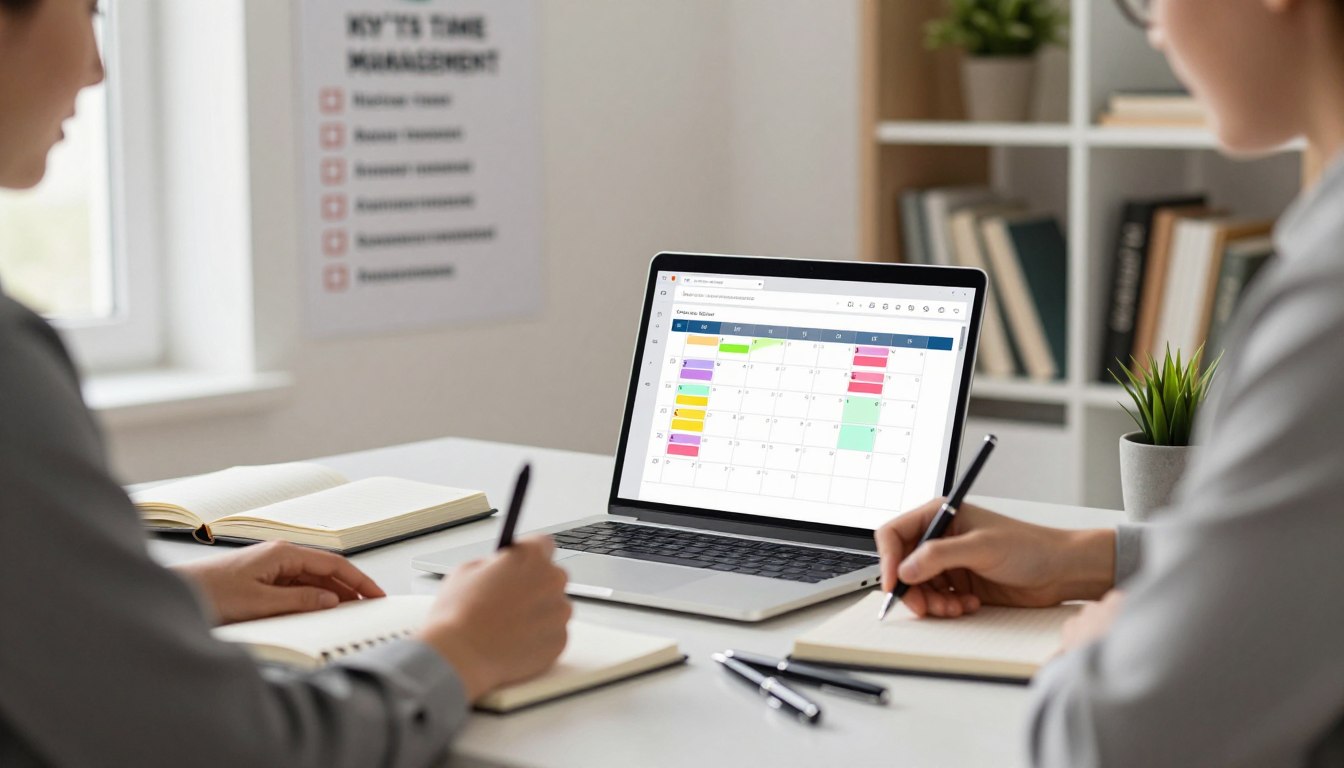
Have you ever reached the end of a long workday only to wonder where all your hours went? Many high-achievers feel like they are constantly running on a treadmill, yet they never seem to reach their final destination. Mastering your daily routine is the secret to reclaiming your focus and achieving your biggest goals.
By implementing effective scheduling, you can transform your workflow and reduce daily stress. Our guide explores proven productivity tips that help you prioritize what truly matters. When you stop reacting to every email and start planning with intent, you gain the freedom to excel in your career. This approach to Time Management ensures that your most important objectives receive the attention they deserve.
Key Takeaways
- Prioritize high-impact tasks to boost your daily output.
- Use intentional planning to reduce workplace stress.
- Adopt proven systems to regain control of your calendar.
- Focus on your most important objectives first each morning.
- Navigate the modern work environment with greater clarity and ease.
The Psychology of Productivity
True efficiency begins when you stop fighting your natural rhythms and start working with them. Many professionals view time management as a rigid set of rules, but it is actually a delicate balance of biology and mindset. By aligning your schedule with your internal clock, you can unlock levels of focus that were previously out of reach.
Understanding Your Biological Prime Time
Every individual possesses a unique chronotype, often referred to as your biological prime time. This is the specific window during the day when your energy, alertness, and motivation are at their absolute peak. Identifying this window is a cornerstone of effective time management for high achievers.
If you are a morning person, your brain is likely sharpest shortly after waking up. Conversely, night owls may find their creative flow late in the evening. You should reserve your most demanding tasks for these high-energy periods to ensure maximum output.
The Impact of Cognitive Load on Daily Output
Your brain has a finite amount of mental energy to spend each day. This concept, known as cognitive load, explains why making dozens of small decisions can leave you feeling exhausted by the afternoon. When you overload your mental capacity, your ability to perform complex time management tasks drops significantly.
To maintain peak performance, you must protect your focus by minimizing unnecessary distractions. Strategic rest is not a luxury; it is a biological necessity that allows your brain to reset. By managing your cognitive load, you ensure that you remain sharp for the critical decisions that truly move the needle.
| Energy Level | Task Type | Best Time Management Strategy |
|---|---|---|
| High Peak | Deep Work | Focus on complex problem solving |
| Mid-Range | Administrative | Handle emails and scheduling |
| Low Dip | Recovery | Take breaks or light tasks |
Mastering Time Management Strategies
Mastering your day starts with adopting proven systems that turn chaos into structured progress. When you implement reliable time management strategies, you gain the clarity needed to tackle complex projects without feeling overwhelmed. These foundational frameworks help you filter out noise and focus on what truly moves the needle.
The Eisenhower Matrix for Decision Making
The Eisenhower Matrix is a powerful tool for categorizing tasks based on their urgency and long-term impact. By dividing your work into four distinct quadrants, you can easily distinguish between what is truly important and what is merely a distraction.
This method encourages you to prioritize tasks that align with your core objectives while delegating or eliminating low-value activities. Using these prioritization techniques ensures that your energy is spent on high-impact work rather than reactive busywork.
Applying the Pareto Principle to Your Workload
The Pareto Principle, often called the 80/20 rule, suggests that 80% of your results typically stem from 20% of your efforts. Identifying these high-leverage activities is essential for effective Time Management in a fast-paced environment.
When you focus your limited time on the tasks that yield the greatest return, you maximize your output significantly. Efficiency is not about doing more things; it is about doing the right things that drive meaningful progress.
Setting SMART Goals for Long-Term Success
To maintain momentum, your professional objectives must be clear and actionable. The SMART framework requires that every goal you set is Specific, Measurable, Achievable, Relevant, and Time-bound.
- Specific: Define exactly what you want to accomplish.
- Measurable: Track your progress with concrete data.
- Achievable: Ensure your goals are realistic given your resources.
- Relevant: Align tasks with your broader career vision.
- Time-bound: Set firm deadlines to maintain focus.
By applying these standards, you transform vague intentions into a concrete roadmap for success. This structured approach keeps you accountable and helps you measure your growth over time.
Implementing Time Blocking for Deep Work
Time blocking transforms a chaotic to-do list into a structured roadmap for success. By dedicating specific chunks of your calendar to singular objectives, you reduce the mental fatigue caused by constant task switching. This approach is one of the most effective productivity tips for professionals who need to produce high-quality results under tight deadlines.
Structuring Your Day with Themed Blocks
The core of effective scheduling lies in grouping similar activities together. Instead of jumping between emails, creative writing, and administrative tasks, you assign specific themes to different parts of your day. For example, you might dedicate your morning to “Deep Work” and your afternoon to “Communication and Meetings.”
This method minimizes the cognitive cost of shifting your focus. When your brain stays in one “mode,” you can achieve a state of flow much faster. Consider the following comparison of common scheduling approaches:
| Method | Primary Benefit | Best For |
|---|---|---|
| Time Blocking | Deep Focus | Complex Projects |
| Task Batching | Efficiency | Routine Admin |
| Reactive Scheduling | Flexibility | Client Support |
Protecting Your Focus During High-Priority Tasks
Once you have your blocks set, you must defend them against external noise. Treat these sessions as non-negotiable appointments with yourself. Use tools like “Do Not Disturb” modes on your devices to ensure that your time blocking efforts remain undisturbed.
“The ability to focus without distraction is a superpower in our increasingly noisy world.”
Communicate your availability clearly to your team so they know when you are unavailable for meetings. By setting these boundaries, you create a sanctuary for your most important work. This level of discipline is essential for maintaining long-term output.
Handling Interruptions Without Losing Momentum
Even with the best plans, unexpected interruptions will happen. When a distraction occurs, the goal is to return to your task as quickly as possible. Keep a “distraction pad” nearby to jot down urgent thoughts that pop up, allowing you to clear your mind and refocus immediately.
If an interruption requires more than a few minutes, adjust your time blocking schedule rather than abandoning it entirely. Flexibility is key to effective scheduling. By acknowledging the disruption and resetting your intent, you maintain control over your day and continue to apply these productivity tips to reach your goals.
Advanced Prioritization Techniques
Advanced prioritization techniques can transform how you handle your most demanding professional responsibilities. While basic lists help you track tasks, they often fail to distinguish between urgent requests and long-term goals. By adopting more robust time management strategies, you gain better control over your daily output.
The ABCDE Method for Daily Planning
The ABCDE method provides a clear hierarchy for your to-do list. You assign a letter to each task based on its importance and potential consequences.
- A tasks: Must be done; serious consequences if ignored.
- B tasks: Should be done; mild consequences.
- C tasks: Nice to do; no real consequences.
- D tasks: Delegate to someone else.
- E tasks: Eliminate entirely to save time.
Eat the Frog: Tackling Difficult Tasks First
The “Eat the Frog” concept encourages you to identify your most challenging task and complete it early in the day. By finishing your hardest work first, you build positive momentum that carries you through the rest of your schedule. This approach prevents the anxiety of looming deadlines from draining your focus.
Managing Energy Instead of Just Time
Effective professionals recognize that time is finite, but energy is renewable. Instead of forcing work during low-energy periods, align your most difficult tasks with your peak biological hours. Strategic rest is just as important as intense work, ensuring you remain sustainable over the long term.
| Method | Primary Benefit | Best Used For |
|---|---|---|
| ABCDE | Clear Hierarchy | Complex Daily Lists |
| Eat the Frog | Momentum Building | High-Impact Tasks |
| Energy Management | Sustainability | Long-Term Performance |
Leveraging Modern Time Management Apps
Modern professionals often find that the right digital tools can transform a cluttered workday into a model of efficiency. By integrating time management apps into your daily routine, you gain the ability to focus on what truly matters. Technology acts as a powerful ally when you use it to automate your planning and tracking processes.
Using Todoist for Task Organization
Todoist stands out as a premier choice for those who need to keep their daily responsibilities in check. It allows you to break down large projects into actionable steps, ensuring that nothing slips through the cracks. You can easily set deadlines, assign priority levels, and track your progress toward long-term goals.
Tracking Billable Hours with Toggl Track
For freelancers and consultants, accurate reporting is essential for maintaining professional credibility. Toggl Track is one of the most reliable time tracking tools available for monitoring your billable hours. It provides clear insights into how you spend your day, helping you identify areas where you might be losing valuable time.
By using these time tracking tools, you ensure that every minute of your work is accounted for. This level of transparency helps you build trust with clients while improving your own awareness of how long specific tasks actually take to complete.
Collaborating Efficiently with Notion
Notion serves as a centralized hub for team collaboration, keeping all your documentation and project timelines in one accessible location. It eliminates the need to jump between multiple platforms to find critical information. Teams can share notes, track project status, and store important files in a single, organized workspace.
| Tool Name | Primary Function | Best For |
|---|---|---|
| Todoist | Task Management | Daily To-Do Lists |
| Toggl Track | Time Tracking | Billable Hours |
| Notion | Collaboration | Project Documentation |
The Art of Task Delegation
If you feel like a bottleneck in your own business, it is time to embrace the power of task delegation. Many high-achievers mistakenly believe that doing everything themselves is the only way to ensure quality. However, this mindset often limits your growth and prevents you from focusing on high-impact strategic work.

Identifying Tasks Suitable for Outsourcing
Not every responsibility requires your personal touch. To begin, audit your daily activities and categorize them based on their value and complexity. You should look for tasks that are repetitive, time-consuming, or outside your core expertise.
- Administrative duties like scheduling and email management.
- Data entry or routine reporting tasks.
- Social media posting and basic content updates.
- Research projects that follow a clear, documented process.
Communicating Expectations Clearly to Your Team
Effective task delegation relies heavily on clear communication. When you hand off a project, provide a detailed brief that outlines the desired outcome, deadlines, and quality standards. Avoid vague instructions that leave room for guesswork.
It is helpful to ask your team member to summarize the instructions back to you. This simple step ensures that everyone is aligned before the work begins. By setting these expectations early, you reduce the need for constant oversight and build trust within your team.
Overcoming the Perfectionism Barrier
The biggest hurdle to successful task delegation is often internal. Many leaders struggle with the fear that others will not meet their exact standards. You must accept that “done” is often better than “perfect” when it comes to scaling your operations.
“The best executive is the one who has sense enough to pick good men to do what he wants done, and self-restraint enough to keep from meddling with them while they do it.”
Start by delegating smaller, low-risk tasks to build your confidence in your team’s abilities. As you see them succeed, you will find it easier to let go of larger responsibilities. Remember, your goal is to lead, not to perform every single task yourself.
Overcoming Procrastination and Distractions
Procrastination acts as a silent thief of your professional potential. When you feel overwhelmed, it becomes easy to lose sight of your goals and drift toward less important tasks. Implementing effective productivity tips can help you regain control and maintain your momentum throughout the day.
Utilizing the Pomodoro Technique for Sustained Focus
The Pomodoro Technique is a simple yet powerful method to keep your brain sharp. By breaking your work into 25-minute intervals followed by a five-minute break, you prevent mental fatigue. This rhythm encourages you to commit to a single task without the pressure of an endless to-do list.
- Set a timer for 25 minutes of deep work.
- Take a short, restorative break when the timer rings.
- Complete four cycles before taking a longer break.
Creating a Distraction-Free Workspace Environment
Your physical surroundings play a massive role in your ability to concentrate. A cluttered desk often leads to a cluttered mind, which hinders your daily output. You should aim to design a sanctuary for your most important projects.
Keep only the essentials within reach to minimize physical interruptions. If you work in a shared office, consider using noise-canceling headphones to signal that you are in a deep work state. These small changes are essential productivity tips for anyone looking to sharpen their focus.
Managing Digital Notifications and Email Overload
Digital noise is perhaps the greatest enemy of modern efficiency. Constant pings from messaging apps and email alerts break your concentration and force you to switch contexts repeatedly. To combat this, try batching your communication tasks into specific windows of time.
Disable non-essential notifications on your phone and computer during your most productive hours. By checking your inbox only at set intervals, you protect your mental energy for high-priority work. Mastering these productivity tips will allow you to finish your day feeling accomplished rather than drained.
Maintaining Sustainable Work-Life Balance
True productivity is not about how many hours you log, but how well you protect your personal time. Many high achievers fall into the trap of believing that constant availability is the key to success. In reality, your brain requires periods of rest to maintain peak cognitive function.
By utilizing effective scheduling, you can ensure that your professional output remains high without sacrificing your well-being. This approach allows you to dedicate your best energy to your most important tasks while leaving room for genuine recovery.
Setting Firm Boundaries Between Work and Personal Time
Establishing clear lines between your office hours and your home life is essential for mental clarity. When you fail to set these boundaries, work stress often bleeds into your evening, preventing true relaxation. Consistency is your greatest ally in this process.
Try to physically or digitally disconnect once your workday concludes. This might mean turning off notifications on your phone or closing your laptop completely. When you respect your own time, others will eventually learn to respect it as well.
The Importance of Scheduled Downtime and Recovery
Scheduled downtime is not a luxury; it is a biological necessity for long-term performance. Just as an athlete needs rest days to build muscle, your mind needs downtime to process information and solve complex problems. Without this, your creative output will inevitably decline.
“Rest is not idleness, and to lie sometimes on the grass under trees on a summer’s day, listening to the murmur of the water, or watching the clouds float across the sky, is by no means a waste of time.”
You should treat your recovery time with the same level of seriousness as a client meeting. Whether it is a hobby, exercise, or simply quiet reflection, these moments recharge your mental batteries. Using time tracking tools can help you identify if you are consistently carving out this necessary space in your calendar.
Avoiding Burnout Through Mindful Scheduling
Burnout is the silent enemy of professional excellence. It often creeps in when we ignore our need for balance and push ourselves beyond our limits. Time blocking serves as a powerful defense against this exhaustion by forcing you to allocate specific slots for both work and rest.
Mindful scheduling involves being realistic about what you can achieve in a single day. By prioritizing your health, you ensure that you can sustain your career trajectory for years to come. Remember that your value is not defined solely by your output, but by your ability to remain healthy and engaged over the long term.
Conclusion
Achieving peak performance requires a shift in how you view your daily schedule. Intentionality serves as the foundation for every successful career path.
Mastering your time remains a continuous process of refinement and self-awareness. You will find that small adjustments lead to significant gains in your output over time.
Experiment with these strategies to discover what works best for your unique workflow. Consistency turns these habits into a natural part of your professional life.
Start your journey today by picking one technique to implement immediately. Small changes create the momentum needed for long-term success and a balanced lifestyle.
Your ability to manage focus determines your future growth. Take control of your calendar and watch your productivity reach new heights.
FAQ
What are the most effective time management strategies for someone with a packed schedule?
To reclaim your day, start by implementing effective scheduling and intentional planning. Techniques like the Eisenhower Matrix help you categorize tasks by urgency and importance, while the Pareto Principle ensures you focus on the 20% of activities that produce 80% of your results. By mastering these time management strategies, you can reduce daily stress and significantly increase your professional output.
How can I use my biology to improve my daily productivity?
Understanding your biological prime time is a game-changer. This involves identifying the specific hours when your energy and focus are at their peak and aligning your most demanding tasks with those windows. By managing your cognitive load and working with your natural rhythms rather than against them, you can maintain high performance without reaching the point of mental exhaustion.
What is time blocking and how does it help with deep work?
A: Time blocking is a method where you divide your day into dedicated segments for specific tasks or “themed blocks.” This approach minimizes the mental cost of context switching and allows you to protect your focus for high-priority projects. Using effective scheduling to create these boundaries ensures that your most valuable work receives uninterrupted attention, even in a fast-paced environment.
Which time management apps are best for staying organized?
There are several powerful time management apps available today. For task organization and project tracking, Todoist is an industry favorite. If you need time tracking tools to monitor billable hours and improve awareness of how you spend your day, Toggl Track is an excellent choice. For those who need a centralized hub for team collaboration and documentation, Notion offers a highly customizable platform to keep everyone on the same page.
How do I handle difficult tasks without procrastinating?
One of the best productivity tips is to “Eat the Frog,” which means tackling your most challenging or unpleasant task first thing in the morning. To maintain focus throughout the rest of the day, you can utilize the Pomodoro Technique—working in short, timed bursts followed by brief breaks. This helps build momentum and prevents the mental fatigue that often leads to procrastination.
Why is task delegation so important for professional growth?
Effective task delegation allows you to scale your impact by shifting routine or specialized tasks to other team members. The biggest barrier to this is often perfectionism. By clearly communicating expectations and focusing on results rather than micro-managing the process, you can free up your time for high-level decision-making and strategic planning.
How can I manage digital distractions and email overload?
Creating a distraction-free workspace is essential. This includes silencing non-essential digital notifications and setting specific times to check your email rather than reacting to every ping. By proactively managing your environment and using prioritization techniques, you can ensure that technology remains a tool for productivity rather than a source of constant interruption.
What is the best way to maintain a sustainable work-life balance?
Sustainability comes down to setting firm boundaries between your professional and personal life. It is vital to schedule downtime and recovery just as strictly as you schedule meetings. By incorporating mindful scheduling and recognizing that rest is a prerequisite for high performance, you can avoid burnout and maintain long-term excellence in your career.